
Brand New 1957 Four Barrel Aluminum Intake Manifold for the Y Block!


The brand new, aluminum, 1957 ECZ 9425 B casting was compared to original cast iron.
Brand New Stock Parts!
The aftermarket for the Y Block certainly is being enlarged by new parts and castings, however many of these tend to be high performance options. Blue Thunder and John Mummert lead the charge for intake manifolds, but even in Australia the "Y Bloke" is producing new castings for the Y Block that is supercharger oriented. Companies such as CRT, Petronix, MSD, etc all have upgraded ignition offerings for the Y Block to "wake it up" and give you more power.
Very few manufacturers are making new stock castings. Granted, there are stock hard parts such as stock timing chains, water pumps, oil pumps, and even rocker arm shafts that can be purchased off the shelf. However, castings such as a timing cover, intake manifold, or exhaust manifolds are almost non-existent. Speedway is reproducing the ram's horn exhaust manifolds (center dump, original HD truck application), and they are stock castings, but no one is reproducing the passenger car exhaust manifolds.
Enter Mercury 8 Restorations in Australia. I referenced this company back in 2025 in one of my YouTube videos: How to Find Parts for the Y Block Ford V8. While I do not know anyone associated with this outfit, it does seem that the scarcity of the 1957-64 large four barrel intake manifold down under has motivated this company to reproduce the casting. A few months back I was considering purchasing one from them just to review and test it out, but got busy with several other items in the Y Block world and tabled the idea.
Just last month, I became aware of Top Street Performance also had a 1957-64 large four barrel aluminum intake for the Y Block and the price was... $210? Ummmm, what? You cannot hardly buy an original, good, cast iron intake manifold for that price. And now a new aluminum casting? I just had to purchase one and check this out! In the interim between my transaction online and the arrival of the intake manifold to my doorstep, I ended up discovering that TSP was selling the exact casting from Mercury 8 Restorations. It was almost like TSP was a US supplier for this Australian company.
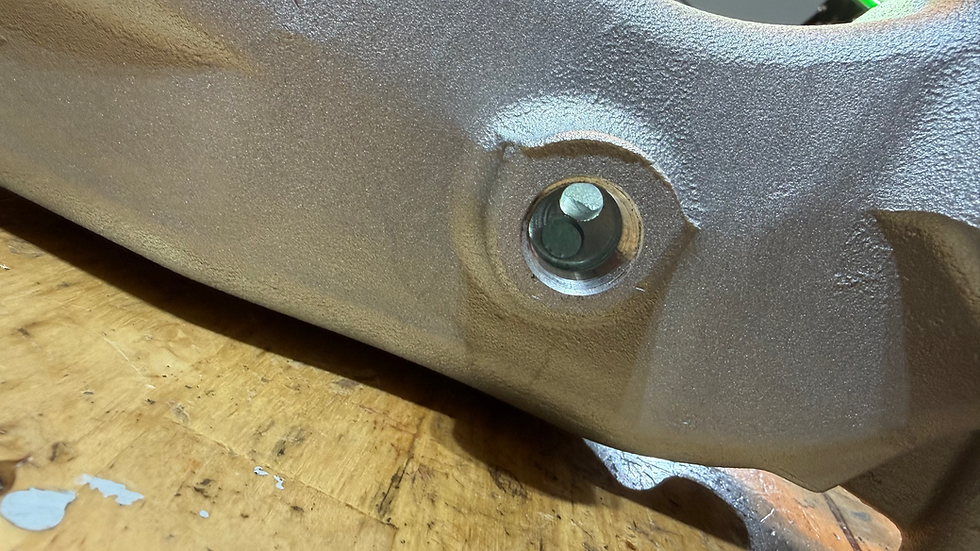
The new intake even has the vacuum port at the rear just like the original casting.
Is it Worth the Money?
This is an answer that you will have to discover for yourself, but I can certainly help with an assessment. First, let me review the positives...
Price: at $210 USD for a new aluminum intake, this is quite a deal.
Weight: the intake comes in at a paltry 12 lbs; that is quite a weight reduction.
Finish: the machine work was better than expected for a $200 intake made in China.
Application: all original thread sizes, port sizes, and locations are very good.
While the casting was not quite up to OEM standards, it did appear as a good enough copy to run.
Now for the negatives, although there were not that many.
Butterfly Ports: These were the smaller size of the two that Ford made for the run of the original 1957-64 "B" intake. The original 1957 four barrel carburetor had small butterlfies like the 55/56 Holley 4000's. If you want to run any kind of aftermarket carburetor, or even a late 50's/early 60's four barrel carburetor, your butterflies will have interference unless you run a spacer. (Most of us do.) When you do use a spacer you will have a ledge made by the smaller throats because essentially you are decreasing the diameter of each barrel as the air flows.
Coolant Ports: The video below shows the detail of the coolant ports, but for all practical purposes the ports are elongated and not completely circular like original. The ports are still matched to the heads, but there is just a bit of an offset that is very apparent when an intake manifold gasket is used as an alignment tool.
Intake Ports Ledge: One side of the manifold had intake runner ports that did not line up with the gasket without creating a ledge between the intake and the head. This is not an issue with the original cast iron intake (as the video below shows). If you have a stock engine are not concerend about getting the maximum cfm from your setup then this is really not a concern. It did appear that there would be no issue with vacuum leaks; only that the ports were off about 3/16" in alignment to the runners on the heads.
No Exhaust Tube: Some may see this as a positive, but if you are running an original 1957 carburetor you will need heat from your intake to make your choke work correctly. In the late 50's, Ford carburetors received their heat from off the exhaust manifold for the thermostatic choke, but by that time the bores for the butterflies were larger. I am not sure why the casting does not reflect that part of Ford's design.
Plenum Floor Oddity: While it may not be a real problem on a stock engine, I do find it odd that for a dual plane intake one side has a plenum floor that is ribbed (to help the air/fuel mixture) and one side is completely smooth. The original Ford casting (all of them, really) has the plenum floors underneath the carburetor with the corresponding ribs. Others who have run this intake on a stock engine have not found any irregularities in engine operation.
All in all, the new casting is a tremendous help if you need a budget-friendly 4 barrel intake.
My friend Ted Eaton has tested this intake manifold on his dyno and gives this report:
I have already tested the Mercury 8 Restoration intake manifold which is the same as the TSP manifold. The M8R intake manifold dyno tested as being the same as the factory ECZ-B manifolds. From a flow number standpoint, the M8R manifold would be suitable for a small camshaft upgraded Ford Y but when needing additional air flow due to cubic inch increase and/or upgrades to compression and camshaft, then the Blue Thunder and Mummert intakes would be a better out of the box option. Some porting of the M8R manifold would be recommended when serious performance is being considered for the Ford Y. Simply increasing the carb bore size on the M8R intake manifold showed a significant increase in the power numbers. I had Joe Craine flow test several different manifolds including the M8R intake and those flow numbers reaffirmed the dyno results. It was during that series of dyno tests that a difference in power numbers in the factory ECZ-B manifolds was noted pointing to differences in the various molds being used to cast the ECZ-B manifolds. Summarized, not all the ECZ-B intake manifolds were created equal. Sort of helps to explain why some engines ran better than others.

Ted and the Hot Rod Reverend in the staging lanes at the 2021 Y Block Nationals.
Conclusion
It does give a little hope for the future to see companies investing in the market for new Ford Y Block parts. Availability like this will certainly help all of us as Y Block enthusiasts keep our engines on the road and encourage others to consider choosing the Y Block for other applications beyond the original car or truck. This intake manifold is certainly worth the money and for a stock engine would be a better option than modifying an original 1955/56 four barrel manifold with an adapter in order to install a modern carburetor.

Word on the street is that there may be all new silicone valve cover gaskets available for the Y Block Ford V8 in the coming months! Plans are in the works as Real Gaskets Tennessee has received good sets of originals (and another original gasket for the Y Block which will remain anonymous right now) from someone you may know. Wink, Wink... Stay tuned!
The Hot Rod Reverend
aka Daniel Jessup


Comments